|
LATIN
DANCE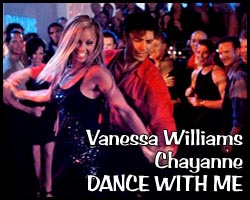
Salsa
(from Cuba & Puerto Rico), Bachata
& Merengue (from
the Domincan Republic) - energetic and passionate dances, they
can also be subtle and sensual. In Ithaca, there is great latin dancing
at several venues: Oasis, Level B, Castaways, Tompkins County Latino
Civic Association annual events. There are big salsa venues in Syracuse,
Binghamton, and Rochester. Check the CNY
Dance Calendars. In addition to the usual focus on footwork
and moves, ithacadance classes focus strongly what to listen
for in the music, on movement styles, and how both ladies and
guys can have fun as dancers, not just as "leaders"
& "followers!"
SWING DANCE
Jumpswing, Lindy Hop/Jitterbug, West Coast Swing, East Coast
Swing, Balboa, Carolina Shag, St. Louis Shag, Push Whip, Imperial, Hand
Dancing... This is a very short list of the swing dance styles to evolve
out of the 1930's and 1940's - there are plenty more regional styles,
both USA and worldwide. But it all started in the USA - an amalgamation
of European and African music/dance styles created by African-Americans,
starting in New Orleans, the second hub being Harlem NY> In Ithaca,
the first four styles are the most known. Teens on American
Bandstand danced a simplified form of what is now called East
Coast Swing - it is recognized worldwide. It is a good place to start
for older beginning dancers, and worth knowing by all dancers. Swing
dance is America's perfect marraige of African & European temperments,
and music/dance traditions. I have written a lot about this at ithacaswingdance
My DVD set has
a charming history segment on this topic. Blues Dancing, although a
century old has gottne a boost as a result of the modern Lindy Hop scene.
MUSIC: Not just Benny Goodman, Count Basie, etc., not just Elvis
Presley, Chuck Berry, etc. Great jitterbug music by the Beatles ("Can't
Buy Me Love"), Stevie Wonder ("Part Time Lover"), Martha
Reeves ("Heat Wave"), Kenny Loggins ("Footloose"),
Billy Joel ("For The Longest Time"), Madonna ("Hanky
Panky"), John Travolta/Olivia Newton-John ("You're The One
That I Want"), etc, etc.
Venues for Swing include Jumpswing Club Rooftop Mayhem, Cornell
Swing Dance Club, ISDN, and various monthly and annual events, such
as Grassroots and Ithaca Festival. Check
the calendar for details. Rooftop Mayhem's annual February big band valentine's
dance is a local highlight.
BALLROOM DANCE
The worldwide ballroom craze can justifiably be traced back
to ex-slapstick comedy vaudevillian Vernon Castle and his wife,
actress Irene Castle in the pre-World War One era. They tamed
the wild dances of the time, adapted various ethnic folk partner dances,
made them attractive to more reserved and refined temperments, and defined
lead-follow style dancing for generations to come. The Castles ushered
in an era when social partner dances were THE entertainment phenomenon
of society. TV was not yet even dreamed of in the wildest imagination
(except in the mind of Nicola Tesla).
Some of the dances that the Castles created/adapted have become extinct,
and some have evolved into modern ballroom standards with the original
or changed names. Their student Arthur Murray took the Castles' creative
and adaptive work towards even further lengths. The most popular modern
social ballroom dances include Waltz, Tango, Foxtrot, Swing, Merengue,
Salsa/ Mambo, Cha cha. More dedicated ballroom enthusiasts also enjoy,
Samba, Quickstep, Paso Doble and Viennese Waltz. Our experience has
shown that the Castle Foxtrot, one of the earliest American ballroom
dances, is a most excellent beginner dancer strategy. It is enjoyable,
easy to learn, and very practical. See info under each dance
on this page.
WEDDING DANCE
Most couples prefer a nice romantic slow song for their
bridal/wedding/first dance (although a few want an uptempo tune!). Slow
songs are played more at weddings than at clubs, since slow songs tend
to draw larger numbers of guests, especially older couples, on to the
dance floor. There are a vast number of wonderful slow tunes to choose
from in all eras of popular music. Out of all the dance styles, we feel
that the Castle Foxtrot, created by Vernon
and Irene Castle, is the easiest access point to ballroom dance for
the beginner, as well as the most practical dance style to learn. The
Castle Foxtrot is also very satisfying and fun, and open to endless
variation as one advances in dancing. One can learn it quicky, making
it suitable for bridal couples starting just a few months or less before
their wedding. Our Wedding
Dance DVD, which we are very pleased with, is currently available.
SALSA
 At
its core, Salsa is a fun Caribbean-rooted dance, and appeals to playful,
creative, energetic types with a sense of humor. Translation: "Sauce."
Salsa's roots are Africa and Spain. These influences came
together in the Caribbean countries of Cuba and Puerto At
its core, Salsa is a fun Caribbean-rooted dance, and appeals to playful,
creative, energetic types with a sense of humor. Translation: "Sauce."
Salsa's roots are Africa and Spain. These influences came
together in the Caribbean countries of Cuba and Puerto 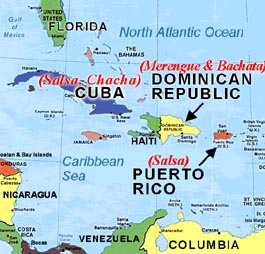 Rico, where Afro-Hispanics created the music and dance. The music
was created in 1938 by Cuban cellist and composer Oreste Lopez,
an evolution of the Cuban Son. He called the music Mambo.
Rico, where Afro-Hispanics created the music and dance. The music
was created in 1938 by Cuban cellist and composer Oreste Lopez,
an evolution of the Cuban Son. He called the music Mambo.
But it was his friend,
bandleader, composer, and fan of American jazz, Perez
Prado who put Mambo into a big band format. Prado was
the first "Mambo King," touring and recording extensively.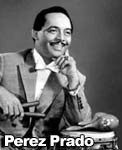 In addition, Perez Prado created the actual Mambo dance
in 1948. You can hear his recordings on Amazon, itunes, etc. Prado
wrote the original Mambo No.5, a huge hit again decades later
(1999), when covered by Lou Bega.
In addition, Perez Prado created the actual Mambo dance
in 1948. You can hear his recordings on Amazon, itunes, etc. Prado
wrote the original Mambo No.5, a huge hit again decades later
(1999), when covered by Lou Bega.
Many Cuban/Puerto Rican dancers and musicians emigrated to New York
City, Miami, and Los Angeles, especially from the
beginning of the Fidel Castro regime in Cuba. The dance and music
took several big leaps forward in New York CIty in the 1950s-60s. The
huge NYC dance hall The Palladium
was NYC's most prestigious Mambo Club. 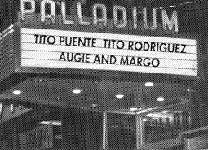 From
the early 1970's onward, the dance/music was re-named SALSA,
and this re-naming gradually became standard worldwide - same dance,
different names (more on this later). Many Cuban composers today
use the names Mambo and Salsa (and even Cha Cha Cha) interchangeably.
FYI - the term "Mambo (Voodoo priestess)" comes from Haiti,
where Voodoo is the main religion. From
the early 1970's onward, the dance/music was re-named SALSA,
and this re-naming gradually became standard worldwide - same dance,
different names (more on this later). Many Cuban composers today
use the names Mambo and Salsa (and even Cha Cha Cha) interchangeably.
FYI - the term "Mambo (Voodoo priestess)" comes from Haiti,
where Voodoo is the main religion.
Style: Salsa is the core of club
latin dancing in Central NY, New York City, Los Angeles, Miami, and
many countries around the world. Salsa can be danced energetically (the
staple style one sees in clubs) or intimately (seen less often). It
can be danced as a strong lead-follow dance, very controlling, with
a lot of complex turns, or the guy can give the lady considerable latitude
to play (Salsa Libre style - our term). Salsa can be just a big
bunch of complex manuevers, or it can be very expressive, or it can
be very playful, flirtatious and sexy. It can also be funny! There is
room for many temperments. When you get a creative guy and a gal who
both have a sense of humor, and have wide boundaries, it can be amazing
to watch. There are circle dances variations (Casino Rueda),
and line dance variations (Salsa Suelta). There are currently
at least three distinct regional USA styles: New York, Los Angeles,
and modern Cuban.
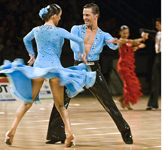 Dancesport:
In the world of Dancesport, there are two main competition divisions:
American and International (UK). This dance is called
Mambo in American Rhythm; there is no Mambo or Salsa in International
Latin. In Dancesport Mambo, the break (the step away from center) is
theoretically on 2. (In a recent Dancesport Competition, I saw many
couples breaking on 1 <wrong>, and a few breaking on 2 <correct>
- however the "1" types usually don't make it to the next
round.) Ballroom people are fond of saying "Salsa breaks
on 1, Mambo breaks on 2," but this is extremely naive.
Many accomplished hispanic salsa dancers break on 1 or 2 or 3 or 4 as
they please. More detail on this follows. Dancesport:
In the world of Dancesport, there are two main competition divisions:
American and International (UK). This dance is called
Mambo in American Rhythm; there is no Mambo or Salsa in International
Latin. In Dancesport Mambo, the break (the step away from center) is
theoretically on 2. (In a recent Dancesport Competition, I saw many
couples breaking on 1 <wrong>, and a few breaking on 2 <correct>
- however the "1" types usually don't make it to the next
round.) Ballroom people are fond of saying "Salsa breaks
on 1, Mambo breaks on 2," but this is extremely naive.
Many accomplished hispanic salsa dancers break on 1 or 2 or 3 or 4 as
they please. More detail on this follows.
The Break: Outside of the Dancesport
world - the clubs, the street dancing - no 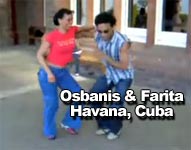 distinction
of Salsa and Mambo exists. Songs use the names Salsa or Mambo interchangeably,
and dancers in various regions break on 1,2,3, or 4. Los
Angeles dancers and native Puerto Ricans tend to break on 1.
Students and followers of the famous Eddie Torres
(NYC street dancer turned pro) religiously break on 2 distinction
of Salsa and Mambo exists. Songs use the names Salsa or Mambo interchangeably,
and dancers in various regions break on 1,2,3, or 4. Los
Angeles dancers and native Puerto Ricans tend to break on 1.
Students and followers of the famous Eddie Torres
(NYC street dancer turned pro) religiously break on 2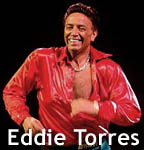 (They call it "Salsa"). A lot of modern Cubans
tend to break on 3. Many native dancers tend not to care on which
beat they break, even changing within the same song. One of the times
I stayed in Santo Domingo, I asked the director of a top Cuban dance
school what beat they break on. He told me that this topic was meaningless
to them. They don't even have a name for "the break." Some
songs have rhythm patterns that lend to a certain break point, so why
force a different one? Some songs will change rhythm patterns, so why
stick to breaking at the same place when the music changes?
(They call it "Salsa"). A lot of modern Cubans
tend to break on 3. Many native dancers tend not to care on which
beat they break, even changing within the same song. One of the times
I stayed in Santo Domingo, I asked the director of a top Cuban dance
school what beat they break on. He told me that this topic was meaningless
to them. They don't even have a name for "the break." Some
songs have rhythm patterns that lend to a certain break point, so why
force a different one? Some songs will change rhythm patterns, so why
stick to breaking at the same place when the music changes?
Movement:
Salsa is a Caribbean dance - the dancers are inspired by the ocean
that surrounds them from birth. They start with body waves, rather
than add them later as a flourish. Stepping to the music's rhythm is
a start for us Northerners, but there is more - legs, hips, torso, shoulders,
arms, hands, head - free movement of energy through the natural channels
of the body from the ground up! This free movement is part of Salsa's
African roots. Salsa is an earth-centered dance, drawing energy
up from the earth. However, one can can enjoy salsa with full body movement
and body waves/ripples, or with very little.
Music: There is a lot of modern
Salsa music. A certain amount of it is hard to dance to, although
it is nice to listen to in the car (which is why composers write it,
and record companies put it out). We sift very carefully through the
available material to select real danceable salsa, and our selections
have received high praise from the best local dancers.
Rhythms: The tumbao
rhythm, played on the congas as 4+ and 8+, is the driving force behind
the whole ensemble. Often it is doubled in the cowbell, or other instruments.
It follows the classic "backbeat"or "upbeat"pattern,
emphasizing beats 2, 4, 6, and 8. This is really the heart of salsa.
It is something you want to tune into for the "feel" of salsa.
Upbeat timing: + 1
+ 2 +
3 + 4 +
5 + 6 +
7 + 8
+
Tumbao timing: + 1
+ 2 + 3 + 4
+ 5 + 6
+ 7 +
8 +
The African-derived clave rhythm
is the "key" of salsa. However, you rarely hear it exprssed
in its entirety. Instruments draw on 3 to 4 beat segments of
the clave for fhythmic ideas. What is the clave? The famous
call and response "Bo Diddley Beat" is precisely the 3/2 clave.
the 3/2 son clave rhythm: ("shave & a haircut -
two bits.")
+ 1 + 2 +
3 + 4
+ 5 + 6 + 7
+ 8
the 2/3 son clave rhtyhm (reversing the 4-beat measures):
+ 1 + 2 + 3
+ 4 + 5 + 6 +
7 + 8
Although we give these numeric rhythms for clarification, good
dancers tend to listen to rhythm patterns in the music - a lot more
fun than abstracting a numbered count from the music, and dancing to
that instead! One of the best web articles on clave
I have found is at the
Latin American Folk Institute.
Salsa timing: + 1
+ 2 +
3 + 4
+ 5
+ 6 +
7 + 8
+
quick-quick-slow-quick-quick-slow
This commonly taught beginners footwork rhythm can be done anywhere
in any combination of body movements, not just the feet. That is a big
difference between Caribean dances and European dances. Also, as in
swing, the dancers can improvise rhythm patterns far beyond this basic
one - dancers are jazz musicians!
MERENGUE
From the Dominican Republic, where it is the National
Dance, Merengue has a strong and joyful groove.
Merengue clearly influenced the creation of USA club dance music. Madonna,
Michael Jackson, Donna Summer, Earth Wind Fire, etc. all owe that disco
groove to a fusion of Merengue and 60s R&B Motown. If you like modern
club dance music and/or disco, merengue is a very practical dance. It
is easy to learn, and it naturally morphs into a 2-step hustle!
The music derives from a cultural melange of African, Hispanic, and
Polish-German-Russian musical temperments: polka got into the
mix (Merengue translates as "mix.")
Merengue got a big push in the 1940s when President (dictator) Rafael
Trujillo made Merengue the national dance, hiring orchestras and
composers, and promoting Merengue ceaslessly - he loved it. The population
did also. The capital, Santo Domingo, is the hub of Merengue
in the Dominican Republic. In DR clubs, Merengue involves simple partner
patterns. I don't think there will ever be an international merengue
competition - it is by nature a simple dance. You almost never see a
lot of fancy turns in DR clubs. Dominicans that study ballroom, swing,
or salsa, learn plenty more moves, but they are the exception. The dance
is more about movement style, than about moves.
Body waves are inherent to the style of all the Caribbean dances.
Learning the subtle hip, rib cage, and body movement styles takes a
bit of work for us Anglos. Again, movement in these Caribbean dances
is inspired by the ocean - it is not about isolations,
it is about the ways energy naturally flows: diagonally across the body
in spirals.
The music is exhilerating, and you really want to move! Merengue moves
can be dynamic, or slow and sexy, although central NY dancers seem to
favor the more energetic style. Merengue has a wide range of tempi -
120-180bpm. There is plenty of great merengue music. It is always mixed
in at salsa club nights locally. Sometimes you see Dominicans emphasizing
one side of the weight shift, the famous Merengue "limp,"
but not always. It is sometimes over-simplified by naive anglo instructors
as "marching in place." The Domincans used to laugh at the
stiff-hipped U.S. Marines in Santo Domingo in 1964-65 attempting to
march the Merengue. Slide your toes on the floor in very small steps
while lfting your heels - keep the weight back and down, not forward
and up. Push off the floor to change weight. Let your weight fully shift
into each step. Relax your hips and they will move.
The most famous merengue artist is Juan Luis Guerra. The brilliant
and beautiful recordings of this Berkeley School Of Music trained artist
are standard in any club scene. However, recent (2008-2009) merengue
radio/club hits seem to be favoring street style, rather than slick
production with top studio musicians - - rough vocals, looser but energetic
rhythms, saxophone rifs barely in tune. Check out recent mega-hits
Vamos Pa' La Playa (Kiko El Presidente) and Ya No Me Amas (Omega).
Merengue drives with two 16th notes into the 1/4 note pulse:
Merengue timing: +a1
+a2
+a3
+a4
+a5
+a6
+a7
+a8
BACHATA
From the Dominican Republic, Bachata (loose trans:
"informal party with guitar music" or "junk")
is related to Merengue,
as a slower dance with a steady 1/8 note division rhythm. Although Bachata
dates to the early 1960s., you would never recognize in its early forms.
In the modern style of Bachata (1980s - present), bongos and acoustic
guitar dominate a light musical texture, and there is also a distinctive
guitar style and tone, AND often a particular guitar, the american-made
Ovation! The rhythm has a clear 1/8 note division, and is very
danceable.
Bachata has from its inception been associated with alcohol and prostitution.
Indeed, the music was most commonly played in brothels, and associated
with the very lowest social classes. It has been called the Blues of
the Dominican Republic. The music was at first vigorously repressed
by the Merengue industry. Bachata arose from back-porch obscurity to
national prominence through the radio in the 1980s, driven by compositions
with sexual double entendre lyrics. The 2006 movie Santo
Domingo Blues is a must-see for bachata lovers. Some current hit
makers are Monchy Y Alexandra, Aventura, Extreme, and Huey
Dunbar. For much more history on Bachata, you may wish to visit
here.
Dancing, a light rise of the hip, alternatively a toe or heel tap or
flick or leg raise, on the 4th and 8th beat of the 8-count phrase is
characteristic, with the usual Caribbean body waves. Bachata can be
danced tight and very sexy, or with plenty of space between the partners
- both are common in its country of origin.
Jorge Elizando is a key figure in modern Bachata dance and instruction
- hot Dominican street style with many added sophistications. One can
think of Bachata dancing in four temperature levels: cool, warm, hot,
and burning, as per the inclinations of the dancers. Real street style
bachata is way too hot for most anglos. Additionally, some Dominicans
enjoy being as exhibitionist as, well... beyond what you want to even
imagine. I have seen it in Santo Domingo clubs - quite amusing, but
most American dancers would be astounded and/or horrified.
As of 2011, there is a new
style called "Dominican Style" which I cannot even describe,
let alone comprehend - very footwork intensive, lots of improvisation
in the footwork - kind of cool and amazing. I will add some video links
at some point.
Bachata timing: + 1
+ 2
+ 3
+ 4
+ 5
+ 6
+ 7 +
8 +
step-step-step-tap step-step-step-tap
HUSTLE
The dance attained its defining characters in the disco era,
but the music lives on through Madonna, Michael Jackson, and the house
music and techno of today. Classic 70s-early 80s artists are Bees Gees,
ABBA, Donna Summer, KC & the Sunshine Band, Earth Wind & Fire,
Barry White, etc. Most music historians agree that the music is a mating
of Dominican Merengue with Rhythm & Blues/ Motown.
The dance style is clearly swing-derived, but with a strong ballroom
flavor. The "one-step" hustle, the simpler version, certainly
owes itself to Dominican Merengue. The 4-step hustle, often taught and
danced +123 or 12+3 makes more sense when taught and danced +123+456,
since hustle music is very different from waltz! Hustle music emphasizes
the upbeats (even beats) of the music - that is an aspect of its R&B
roots.
BOSSA NOVA
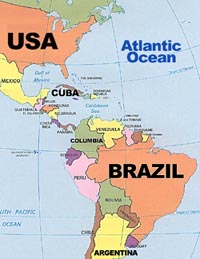 Bossa
Nova music originated in Brazil. Bossa
Nova music originated in Brazil. It has the "cool sensibility"of the Rio De Janeiro
beach scene. Compared to Salsa, although also clave-based, Bossa
Nova rhythms are somewhat less complex, and more mellow. Bossa Nova
is joyful, jazzy, and sensual. The dance is just like the music! Joao
Gilberto single-handedly created the Bossa Nova beat and feel in
1955, an evolution of Brazilian samba (with roots in Africa). Joao brought
his ideas to the brilliant guitarist-composer
It has the "cool sensibility"of the Rio De Janeiro
beach scene. Compared to Salsa, although also clave-based, Bossa
Nova rhythms are somewhat less complex, and more mellow. Bossa Nova
is joyful, jazzy, and sensual. The dance is just like the music! Joao
Gilberto single-handedly created the Bossa Nova beat and feel in
1955, an evolution of Brazilian samba (with roots in Africa). Joao brought
his ideas to the brilliant guitarist-composer  Antonio
Carlos Jobim. Their first actual Bossanova recorded hit was "Chega
de Saudade," (No More Blues) 1959. Antonio
Carlos Jobim. Their first actual Bossanova recorded hit was "Chega
de Saudade," (No More Blues) 1959.
GIlberto and Jobim teamed up with the genius saxophonist Stan Getz,
and many, many worldwide standards emerged. "Girl From Ipanema,"
sung by Astrud Gilberto in 1962 (Joao's wife) was a massive hit
and remains an all-time classic.
There are plenty of Bossa Nova bands to this very day, with new songs
continually emerging, always with that ocean breeze, laid-back, yet
rhythmic feel. The word "bossa" is old Brazilian slang for
an action executed with a natural flair.
As
a dance, there is NO STANDARD for Bossa Nova. What we have found is
that chachacha (mostly) and some rumba rhythms & patterns work great for slower tempos. Salsa
patterns for faster tempos. The music rhythms definitely lend toward a "break" on 2, not 1. Try a
lyrical approach rather than the sharp movements which are typical of ballroom cha cha. Boss Nova music is usually
sensual, subtle and lyrical, rather than passionate, intense and
percussive. Think of ocean waves and ocean breezes, just like the
origianl concept of the music by its creators.
CHA CHA
Cha Cha comes from Cuba. As a dance, Cha Cha Cha (3 Chas
in the original name) is essentially slowed-down Salsa aka Mambo, with
triple steps (chasse steps) 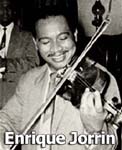 replacing
the hold-steps. Cuban composer and violinist Enrique Jorrin,
created the cha cha beat in 1951 as an outgrowth of Mambo, the current
craze. He introduced the Cha Cha Cha to crowds via the orchestra he
performed with: Orquesta America de Ninon Mondejar. replacing
the hold-steps. Cuban composer and violinist Enrique Jorrin,
created the cha cha beat in 1951 as an outgrowth of Mambo, the current
craze. He introduced the Cha Cha Cha to crowds via the orchestra he
performed with: Orquesta America de Ninon Mondejar.
The first recorded cha cha cha songs, "La Engañadora"
and "Silver Star," hit the Cuban music charts in 1953 as instant
chart toppers, unseating the Mambo King Prado Perez.
In 1952, UK dance instructor Pierre Margolle saw the dance in
Cuba, and developed a ballroom version of it. Margolie helped found
the Imperial Society of Teachers of Dancing (founders of so-called International
Style of ballroom dance).
During the 1950s, its worldwide debut period, Cha Cha became a USA craze
due to dance instruction magnate Arthur Murray, who 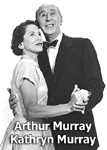 spent
considerable time in Cuba. He shortened the name from Cha Cha Cha
to Cha Cha. Arthur Murray also introduced the simplified rhythm
pattern of 1-2 cha cha cha (breaking on 1, instead of
the original 2)! His famous Arthur Murray Orchestra performed dance
songs written specifically for 1-2-cha cha cha. Many pop, doo-wop, and
rock hits also used this simplified version, so 1-2-cha cha cha was
here to stay as an alternate approach to the rhythm, and purists can
either like it or not. 1-2 cha cha cha is the current American Country
version of cha cha. In ballroom, the chasse steps move - either to the
side or front and back. (NOTE: "the break" is the step
away from center. Anglo dancers and teachers talk a lot about the break
step, but even the professional Cuban dancers and teachers I spoke
with don' t even have a name for it.) spent
considerable time in Cuba. He shortened the name from Cha Cha Cha
to Cha Cha. Arthur Murray also introduced the simplified rhythm
pattern of 1-2 cha cha cha (breaking on 1, instead of
the original 2)! His famous Arthur Murray Orchestra performed dance
songs written specifically for 1-2-cha cha cha. Many pop, doo-wop, and
rock hits also used this simplified version, so 1-2-cha cha cha was
here to stay as an alternate approach to the rhythm, and purists can
either like it or not. 1-2 cha cha cha is the current American Country
version of cha cha. In ballroom, the chasse steps move - either to the
side or front and back. (NOTE: "the break" is the step
away from center. Anglo dancers and teachers talk a lot about the break
step, but even the professional Cuban dancers and teachers I spoke
with don' t even have a name for it.)
A Caribbean dance, there are plenty of body waves on the break steps
- this is what results in the hip motion. Dancesport stylin is
considerably more extravagent than Cuban 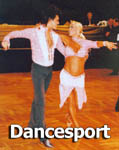 street
styling, which more earthy. Regarding "authenticity," street
dancers in Cuba have TVs and the internet - creative dancers are attracted
to anything that appeals to them, and the extravagences of Dancesport
are no exception - so then what is "authentic styling?" Also,
there are many Latinos are in Dancesport. street
styling, which more earthy. Regarding "authenticity," street
dancers in Cuba have TVs and the internet - creative dancers are attracted
to anything that appeals to them, and the extravagences of Dancesport
are no exception - so then what is "authentic styling?" Also,
there are many Latinos are in Dancesport.
Cuban street dancers, in general, tend to shuffle the cha-cha-cha flat-footed,
rather than get up on the ball of the foot. However, if they are really
moving around a lot of space, the cha-cha-cha becomes a run-run-run
(ball of the foot). Also, the Cuban street dancers tend to do the 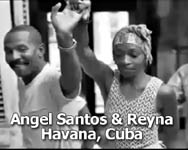 cha-cha-cha
front and back, instead of side-to-side, as is done in most
Dancesport patterns. Both Cuban street dancers and Dancesport dancers
break on "2." However, Cubans tend to start with a
good "stomp" on "1," whereas Dancesport dancers
will do a side step on "1." Moreover, the lead breaks back
first in Dancesport, whereas the lead usually breaks forward first in
Cuban street style. cha-cha-cha
front and back, instead of side-to-side, as is done in most
Dancesport patterns. Both Cuban street dancers and Dancesport dancers
break on "2." However, Cubans tend to start with a
good "stomp" on "1," whereas Dancesport dancers
will do a side step on "1." Moreover, the lead breaks back
first in Dancesport, whereas the lead usually breaks forward first in
Cuban street style.
Cha cha is always played in the mix on club latin nights. Cha cha can
be danced vigorously, or in a very mellow style. If you
keep in mind that Chacha is an offshoot of Salsa, it opens up a lot
of doors very quickly to you as a dancer.
Classic Chacha timing (break on 2 and 6)::
+1 2
3 cha-cha-cha
6
7 cha-cha-cha i.e
+1 2
3
4+5
6
7 8+1
Arthur Murray and modern Country version (break on 1):
+1 2
cha-cha-cha 5 6
cha-cha-cha
RUMBA
European dance teacher Monsieur Pierre (Pierre Margolle) visited
Havana several times from 1947 onwards.He studied the old slow Spanish
Son-Bolero aka Danzon, and got some steps and timing ideas
from dance champions Pepe and Suzy Rivera. 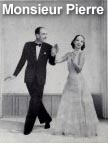 Margolie
created was to become the "International" version for U.K.
dance teachers. Even though Cuban Rumba is a totally different
dance in every imaginable way, Margolie decided to use the name Rumba
for this slow dance, as he felt the name to be a more marketable. For
years, U.K. instructors argued over whether to break on 1 or 2. "2"
won out ofr the U.K., regardless of the rhythms in the music. Margolie
created was to become the "International" version for U.K.
dance teachers. Even though Cuban Rumba is a totally different
dance in every imaginable way, Margolie decided to use the name Rumba
for this slow dance, as he felt the name to be a more marketable. For
years, U.K. instructors argued over whether to break on 1 or 2. "2"
won out ofr the U.K., regardless of the rhythms in the music.
"American" Rumba also uses patterns derived from Waltz.
Ballroom Rumba hit the USA before the first World War, and was a fast
dance, popular in the 1930s with a box step, breaking on 1. Eventually,
American ballroom dancers adopted ideas from the U.K. style, but retaining
the box patterns.
The term "Cuban Motion" was invented by people who
apparently were so stiff that when they visited Cuba, Puerto Rico or
the Dominican Republic, their minds were completely blown - they had
no idea that people could move like that. Cuban Motion refers
to the natural rise of the opposite hip when a foot is lifted, and a
relaxing of the hip when weight is shifted and a leg is straightened,
resulting in a body wave - it is not just the hips. Rumba, Salsa, Cha
Cha, Merengue, Bachata all have this natural body wave as part of the
rhythm.
Ballroom Rumba is VERY different both in music and dance style
to what Cubans call Rumba - a type of fast Guaguanco,
a lascivious barnyard dance imitating animals in heat. And, in case
you were wondering, there is no way we are going to teach Cuban Rumba,
folks. At a Salsa Congress in Boston, I once saw (some very dear
and talented) instructors offer a workshop in Cuban Rumba to
a mixed age group of 12-70, and I could hardly imagine something so
inappropriate - people were dropping out, like, whaaat?? Of course,
all is forgiven - let's keep this last thought for all occasions!
The 8 count American pattern (Arthur Murray style) is:
12 +34 56 +78
Slow and quick-quick Slow and quick-quick
Touch shift-side-together Touch shift-side-together
The Fred Astaire version starts on the quick-quick (side-together):
Quick-quick Slow and quick-quick slow
A lot of social dancers feel that the quick-quick
fits the music much better on 78 than on 12 or on some
other place in the 8-count phrase. They also like
to start with the quick quick, rather
than the slow.
TANGO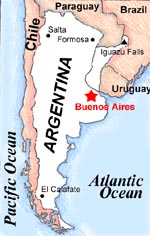
The International and American Ballroom styles
of Tango are popular all over the world, including in its native Argentina.
In contrast to modern Argentine style (which
some say has no basic step) Ballroom Tango is quite accessible
to beginners. Ballroom styles have a well-defined basic step, which
works perfectly to the 8-count musical phrase. Ballroom Tango is essentailly
80% a snapshot of early 20th century salon Argentine Tango.
Tango music has strong Spanish Flamenco and Italian connections,
especially in the bel canto vocal style, and the overall dramatic
operatic quality of the music. Strongly contrasting textures characterize
traditional tango music: long lyrical romantic phrases quicly followed
by sharp pizzicato or sforzando punctuations express the
quickly changing and diverse emotions. The musical arrangements can
have light textures, with violins and bandoleon (a type
of accordian) dominating or full dramatic orchestra, conveying subtleties
and passionate intensity. Tango can be (but it doesn't have to be) a
very varied dramatic dance acting out intense attraction, desire, lust,
affection, passion, revulsion, domination, submission, rebellion, jealousy
and rage - just like Italian opera! For dancers with a dramatic flair,
this is all quite fun. Because of Tango's possibilities of drama and
expressing strong emotions, Hollywood features the dance in many movies,
from the 1920s to the present day (such as "Take The Lead,"
"Scent Of A Woman," "Chicago," "Moulin Rouge,"
"Shall We Dance," "The Tango Lesson," "Evita,"
"True Lies," "Strictly Ballroom," etc. ).
The French stage adopted tango, re-named "Apache" to
act out the often violent emotions of lovers - during performances,
a few women accidentally lost their lives on stage, due to overacting
on the part of the male leads!
Argentna's capital city of Buenos Aires was and is the hub of
tango. Modern scholars say that Tango was born in Argentina 's working
class dance halls. Because of its' lower class roots, the dance was
at first shunned by the upper classes, then later embraced by the aristocracy
as an elegant salon dance. Popular myths, that tango was born in the
city's brothels, or developed as an acting out of prostitute-pimp-patron
drama, or a homo-erotic dance of domination and submission - these are
all very debatable. Under dictator Juan Peron, tango enjoyed
a golden age. Famous tango composers from that time are Osvaldo Pugliese
and Astor Piazzolla. However, when Perron was ousted by a military
junta in 1955, tango was supressed - artists were imprisoned and blacklisted,
tango clubs were restricted. Many other methods were used to suppress
the dance, although it was not blatantly outlawed. This suppression
of the dance continued until the junta fell in 1983.
Tango took the
lead-follow concept to a high level of sophistication. Young Argentinian
aristocrats, brought Tango to France in the pre-World War One era. (A
popular myth says that Argentine sailors were responsible for introducing
Tango to Europe.) Euopean dance instructors (including Vernon &
Irene Castle, who were living in Paris at the time) were fascinated
by Tango's style and the sophisticated lead-follow concepts. They adapted
Tango to the social ballroom. Tango has since evolved into a very subtle
partner dance, in which the lady is given considerable display and opportunity
to create. Ballroom Tango has become a favorite romantic couples dance,
and is a consistent all-time favorite in our college ballroom classes.
Tango timing: + 1
+ 2
+ 3
+ 4 +
5 + 6
+ 7
+ 8
+
slow-slow-quick-quick-slow
aka walk-walk-walk-side-touch
aka walk - walk - Tan-go - closed
aka T - A - N-G - O
SLOW DANCE - CASTLE FOXTROT
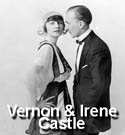 Vernon
and Irene Castle (Vernon Blythe and Irene Foote) single-handedly
created the USA ballroom craze in the pre-World War One era. Their "Castle
By The Sea" was the original ballroom dance mecca in America. Anything
Irene did fashion-wise was immediately copied by millions of women -
bobbing her hair, shorter dresses, etc. The Castles were the first to
codify an American version of the waltz, tango, and more. Arthur
Murray studied with the Castles. Any history of ballrom dance must
focus on the work of Verrnon and Irene Castle. Interestingly, they were
intuitive self-taught partner dancers - prior to ballroom dancing, Vernon
was a vaudeville comedian and tap-dancer. Vernon
and Irene Castle (Vernon Blythe and Irene Foote) single-handedly
created the USA ballroom craze in the pre-World War One era. Their "Castle
By The Sea" was the original ballroom dance mecca in America. Anything
Irene did fashion-wise was immediately copied by millions of women -
bobbing her hair, shorter dresses, etc. The Castles were the first to
codify an American version of the waltz, tango, and more. Arthur
Murray studied with the Castles. Any history of ballrom dance must
focus on the work of Verrnon and Irene Castle. Interestingly, they were
intuitive self-taught partner dancers - prior to ballroom dancing, Vernon
was a vaudeville comedian and tap-dancer.
Foxtrot as a ballroom dance was created in 1914 by ballroom instructor
and exhibition dancer Oscar Duryea. The story is that Foxtrot
was created by and named (Fox's Trot) after popular vaudeville
dancer Harry Fox (born Arthur Cunningford) who debuted
a performance version of the dance on a Manhattan stage. However, there
is eveidence that Duryea actually taught the dance to Harry Fox. Foxtrot
immediately became the most popular dance in the ballroom and cabaret.
Vernon and Irene Castle created a slow version of Foxtrot,
at the suggestion of their bandleader, James Reese Europe. Although
their version was greeted with enthusiasm, it did not continue in the
studios. Vernon & Irene stopped teaching later in 1918, when Vernon
went to Britain to fly with the Royal Air Force in the First World War.
By the time he returned, Irene was already pursuing her first love:
acting, and Vernon's interest now lay in teaching flying to young military
aviators.
The Castle Foxtrot is a great slow dance! There are innumerable wonderful
slow tunes in all eras of popular music. Surprisingly, the International
and American Ballroom Syllabus,contain NOTHING for slow dance (except
Rumba, which requires a very particular rhythm of music, and
is very sophisticated). California instructor Buddy Schwimmer invented
the "Night Club Two Step," using triple steps, for
slow music,. NC2S has a formal feel, and is not as romantic, intimate,
or as easy and relaxed as the Castle Foxtrot. Our version of the Castle
Foxtrot morphs easily into Blues Dance, and NC2S cannot do this.
The Castle Foxtrot follows the natural phasing of most music, making
it instantly enjoyable as a dance style, and lends itself to expansion
with improvised figures. It is strongly rooted in Tango, although considerably
easier to learn. Compared to the commonly taught simple "sway basic,"
the Castle Foxtrot is more interesting, more expressive, follows the
music in a more satisfying way. It is also the perfect wedding dance,
far beyond the common "hug & wobble."
Castle Foxtrot timing: + 1
+ 2
+ 3
+ 4 +
5 + 6
+ 7
+ 8
+ slow-slow-quick-quick-quick-quick
WALTZ
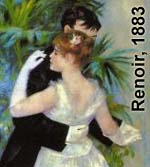 Waltz
is the first "closed position" dance. Originally an
AUSTRIAN folk dance dating back to the 17th century (some say
13th c.), waltz became popular as an unstructured social dance in European
dance halls in the 1800s. It was considered very risqué, indecent
even, due to the closed hold and the turning, turning, turning! For
this reason, waltz was forbidden in some countries and by various religious
groups. Vernon and Irene Castle brought elegance and definition
to the waltz in America at the early part of the 20th century, paving
the way to waltz's social acceptability, (Prior ot the Castles, an early
demonstration of Waltz by a Boston dance instructor was met with horror
by the upper classes.) Waltz
is the first "closed position" dance. Originally an
AUSTRIAN folk dance dating back to the 17th century (some say
13th c.), waltz became popular as an unstructured social dance in European
dance halls in the 1800s. It was considered very risqué, indecent
even, due to the closed hold and the turning, turning, turning! For
this reason, waltz was forbidden in some countries and by various religious
groups. Vernon and Irene Castle brought elegance and definition
to the waltz in America at the early part of the 20th century, paving
the way to waltz's social acceptability, (Prior ot the Castles, an early
demonstration of Waltz by a Boston dance instructor was met with horror
by the upper classes.) 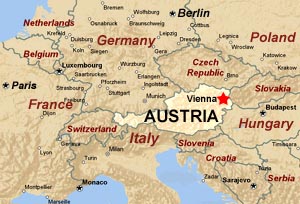 Viennese
Waltz is fast; standard American Style Waltz is slow. Waltz is the
first modern ballroom dance, and was the model for many dances that
followed: foxtrot, rumba, even swing and salsa. Viennese
Waltz is fast; standard American Style Waltz is slow. Waltz is the
first modern ballroom dance, and was the model for many dances that
followed: foxtrot, rumba, even swing and salsa.
Waltz is one of the few ballroom dances that have crossed over into
American Country-Western, Cajun, Folk, and Argentine Tango dance halls.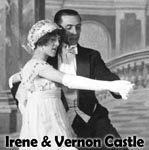 Dr.
Richard Powers at Stanford University has developed a very popular
variation he calls "cross-step" waltz. In the American "roots"
styles, the ballroom "rise and fall" is often omitted. Waltz
has a wonderful gliding feel, like ocean waves. Although written
in 3, waltz phrasing is in 6 - counting waltz in 3 makes it feel
choppy. Yet, some "roots" waltzes are intentionally played
in 3 for that choppy feel. Many of country music's top artists have
recorded very popular waltzes. Waltz timing: +1
+ 2 + 3 + 4 + 5 + 6 +
Dr.
Richard Powers at Stanford University has developed a very popular
variation he calls "cross-step" waltz. In the American "roots"
styles, the ballroom "rise and fall" is often omitted. Waltz
has a wonderful gliding feel, like ocean waves. Although written
in 3, waltz phrasing is in 6 - counting waltz in 3 makes it feel
choppy. Yet, some "roots" waltzes are intentionally played
in 3 for that choppy feel. Many of country music's top artists have
recorded very popular waltzes. Waltz timing: +1
+ 2 + 3 + 4 + 5 + 6 +
FOXTROT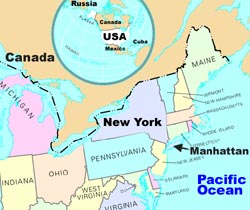
During the swing era, Foxrot was the most popular dance in the
ballroom, a graceful way to dance to the supremely popular swing music
of the time. Foxtrot is still quite high on the list of ballroom dances
worldwide, having undergone considerable development since 1914.
Harry Fox (performer, real name Arthur Carringford) )
debuted the dance in a rooftop show at a Manhattan restaurant, and
it was quickly named "Fox's Trot." Ballroom teacher Oscar
Duryea refined and codified the dance for mass comsumption - and
there is evidence that he actually taught the original dance 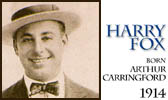 to
Harry Fox. Foxtrot borrows MANY figures from the dance that historically
preceded it in popularity - the WALTZ. In America, Fred Astaire's
foxtrot in movies was considerably influential. Arthur Murray's syllabus
lists 31 bronze level figures, and dancers (and instructors!) find a
lot of ways to combine these patterns of smooth walking steps and quicksteps,
with a 6-count and an 8-count basic. Foxtrot became the basis for the
Texas Two-Step, a dance created by Houston ballroom instructors.. to
Harry Fox. Foxtrot borrows MANY figures from the dance that historically
preceded it in popularity - the WALTZ. In America, Fred Astaire's
foxtrot in movies was considerably influential. Arthur Murray's syllabus
lists 31 bronze level figures, and dancers (and instructors!) find a
lot of ways to combine these patterns of smooth walking steps and quicksteps,
with a 6-count and an 8-count basic. Foxtrot became the basis for the
Texas Two-Step, a dance created by Houston ballroom instructors..
Foxtrot 6-count timing: +1
+ 2 + 3
+ 4 +
5 + 6 + Slow-slow-quick-quick
Foxtrot 8-count timing: +1
+ 2 + 3
+ 4
+ 5
+ 6 + 7
+ 8 + Slow-quick-quick-Slow-quick-quick-
TEXAS
TWO STEP aka Country Two Step
"Texas Two-Step"
aka "Country Two-Step" is popular not only in the south,
but way up into Boston as well,  where
it is a favored staple among the sophisticated ballroom & West Coast
Swing crowds. There is plenty of great two-step music from the 1940s-50s
(Bob Wills, Hank Williams, Loretta Lynn, etc) and up to today (Taylor
Swift, Florida Georgia Line, etc). where
it is a favored staple among the sophisticated ballroom & West Coast
Swing crowds. There is plenty of great two-step music from the 1940s-50s
(Bob Wills, Hank Williams, Loretta Lynn, etc) and up to today (Taylor
Swift, Florida Georgia Line, etc).
The birth of Fox
Trot in 1914 and the birth of Texas Two Step in 1980's have an interesting
parallel. Performer Harry Fox did his show dance, and suddenly
everyone had to do "Fox's Trot." Ballroom instructors of the
time scrambled to create a version danceable by the average person.
Jump to 1980, ballroom instructor Patsy Swayze (yes, Patrick
Swayze's mom!), hired to choreograph the movie "Urban
Cowboy," along with her daughter-in-law Lisa Niemi (Patrick's
wife), virtually created the modern version of this cowboy
dance, patterned heavily off of the "Collegiate Foxtrot"
of the 1950s.
First, Patsy visited several local big dance clubs and watched how people
were dancing to uptempo country music- a variety of things, actually.
Dancers in the movie reflects this variety. Some were dancing slow-slow-quick-quick
(post foxtrot), some quick-quick-slow quick-quick-slow
(like polka, and a common square dance pattern dating to many decades
earlier.) Patricia and Lisa taught John Travolta in the film.
There are a few dancers in the film who are clearly using ballroom techinque
and look very smooth, among the rag tag others - guess who taught them?
Suddenly,everyone wanted to dance the Texas Two-Step.
The dance evolved like crazy to the enormous complexity in the modern
era. The patterns of the Collegiate Foxtrot are the same as those in
modern beginning Texas Two-Step. Like foxtrot, the two-step is a smooth,
gliding dance. The chief difference is at what point the pattern begins:
"Slo-Slo-Quick-Quick" (Foxtrot) vs. starting ½ way
in: "Quick-Quick-Slo-Slo" (Texas 2 Step). Tempos range from
a slow coasting 130bpm to a zippy virtuoso 200+ bpm.
Brief Country
Music Overview: The first commercial recordings of what was considered
"country music" were "Arkansas Traveler"
and "Turkey in the Straw" by fiddlers Henry Gilliland
& A.C. (Eck) Robertson in 1922. Early country music also drew heavily
on African-American blues. In 1925, Nashville's first radio station
WSM began a program that eventually became "The Grand Ole Opry."
Currently, country music draws on many styles, and is often influenced
by hard rock and roll, and even (gasp!) hip hop. Historians of the genre
often mention three distinct periods: Classic Country (1940s
- 1960s), the Golden Age (1980s - 1990s) and Modern Country
Music (post 2000s).
Two Step 6-count
timing: +1 +
2 + 3
+ 4 +
5 + 6
+ quick-quick
slow-slow
JUMPSWING
Jumpswing is a subset of Lindy Hop. But it holds the classic
Swing Out until later in the syllabus. My personal feeling is that Jumpswing
is the easiest and most satisfying entrance into Swing Dance for beginners
of any age. It includes Charleston, Jazz, Jitterbug, Jive and Lindy.
It's 6-count kick basic is more fast Lindy rooted than single-step,
toe-step or triple-step 6 count swing. It is more natural, relaxing,
rhythmic, and just plain feels better and more musical.
Please don't get scared by the name if you are an older dancer
- it doesn't have to jump. The energy level is up to the dancers' choice.
But Jumpswing gets people dancing to the uptempo music that they
like much sooner, and feels better than any swing style that we have
seen or tried for beginners. Our students are not the ones sitting down
when the music is faster! Cornell students liked Jumpswing so much that
they started a Jumpswing club in the mid-1990s (Rooftop Mayhem - now
defunct). Ithaca College students started a Jumpswing club in 2012 -
and it is very much alive.
EAST COAST SWING
Arthur Murray is mostly responsible for the ballroom adaption
of common practice swing era Lindy Hop/Jitterbug patterns and styles.
East Coast Swing with its 6 and 8 count patterns works quite well and
is very enjoyable. Considerably more detail about East Coast Swing
at ithacaswingdance
LINDY HOP
Hugely popular among the upper crust of modern dedicated swing
dancers, Lindy Hop was born in Harlem NY. It was developed by the top
show dancers of Harlem's Savoy Ballroom for themselves. Everyone
within eyeshot copied it and created their own variations. Often felt
to be the Mother of all swing dance styles by its afficianados, actually
it is not, since other styles emerged quite independently of Lindy Hop
- Balboa and Shag to name a couple. Lindy Hop lends itself to individual
interpretation of the music, depending on how deep one responds to music
and hears it.
Like any other dance, beginners do patterns, period, in ever increasing
complexity. Advanced dancers hear more and respond and create and become
a part of the music. Lindy Hop has a steep learning curve, due to its
characteristic move, the notoriously sophisticated SWING OUT. However,
we have developed methods whereby one can learn it well and enjoy it
without constantly evaluating "Is this right?" IF one is willing
to practice. Once it becomes a part of you, Lindy Hop is fun. Although
there are classic gestures, the very natural of this dance is massive
freedom, improvisation, humor, creativity, individuality, and play.
Losing sight of this is losing sight of Lindy Hop. Lots more
history at ithacaswingdance
BLUES DANCE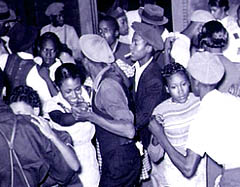
Like swing music and dance, blues is an African-American
creation, from the deep South, to cities in the north, suchas Chicago
and Harlem. In Europe, people didn't dance this close, and in
Africa, people did not dance in couples, or even touching each other.
Blues dancing grew out of the dancer's response to slow, sensual blues
music played in the African-American "Jook Joints." In its
early days (WWI era) through the 1940s, it was called, among other things,
"Slow Dragging." In the 1960s, some were calling it
"Belly Rubbing." By the 1970s, the term "Slow
Dancing" was in wide use. "Blues Dancing"
is the name adopted by the modern Lindy Hop groups, a term that has
also been in common use throughout its time frame.
Blues music tempo
is slow to medium (40-90 bpm), but slow enough so that you can dance
in place without moving your feet! However, if there is any space on
the floor (unlike the photo above!), one can certainly scoot around
the floor, or throw in a flash footwork flurry. There is no predetermined
basic "footwork." Dancers respond to the rhythms and play
with its patterns. Movement can be slow, sultry and evocative, or energetic,
with drastic changes during the dance, depending on the music and mood
of the dancers.
Although lead-follow style predominates, the follower has room to play
around,if given the space (or if she grabs it!). The styles of dancing
vary widely from couple to couple. Blues Dance can be playful, friendly,
intimate, sexual, depending on the mood, dance background, drama, and
the status of the couple. Exploration of partnering methods is common.
Blues dance styles range from as nasty as grinding, to as virginal as
open swing moves, and interpretive jazz. Modern folks with experience
in other dance styles throw in tango and salsa moves, as well as ideas
from studio jazz, ballet, modern, and lyrical dance. 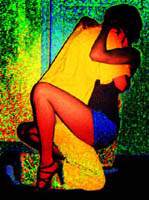
Uniquely, there are a huge variety of ways for weight-shifting to
the beat. Partnered body rolls and waves are a big aspect of blues dance.
It is amazing how many ways one can divide weight-shfting, far more
subtle and complex than just "your weight is on your right, now
it's on your left." The motions and ways to lead are also numerous
- circles, spirals, figure eights, up motion, down motion, leading with
thighs, hips, belly, ribs, chest,and so on. There are a whole range
of dips, and movement within the dips themselves.
Live out your "bad boy" and "bad girl" fantasies!
The classic 1987 movie "Dirty Dancing" has a staff
party scene with a bunch of way over the top dirty dancing. Although
the dancing in this scene is typically ultra Hollywood-ized, and devoid
of subtley, it is not without interest! Modern (2012) K-style Bachata
(created by India's Salsa king Karma "Kaytee" Namgyal)
has moves clearly inspired by this scene.
"In those
days, when the music was slow, you held the girl close.....At parties,
we'd put the lights down low, grab a girl and just lay her up against
the wall..." -
Ambassador of Lindy Hop (Frankie Manning & Cynthia Millman,
2007)
WEST COAST SWING
West Coast Swing is the state dance of California. It
was originally called Sophisticated Swing in the late 1930s.
And has it ever lived up to its name! It is a favorite of dance professionals
with extensive training in ballroom and latin dance. West Coast style
gives the lady plenty of room to express herself to the max. West Coast
style needs full body movement and musical expression, otherwise it
is flat and tedious-looking. The real dancers are "musicians of
the bod," if this means something to you. Nowhere is this more
evident than in West Coast Swing. More West Coast Swing history at ithacaswingdance
CAROLINA SHAG
Carolina Shag is the state dance of North Carolina. Hundreds
of thousands of shag fans reside in the Southeastern states, compared
to a handful in the Northeast. Shag has a great look. Beach Music
is its music, a name that is virtually unknown in Northern music stores.
Beach Music is essentially R & B, but with a kind of flavor that
you would have to hear a bit of, to know what I mean. Beach songs tend
to be R&B type, nostalgic of the Carolinas, the South, the Beach.
I went down to Myrtle Beach and Georgia specifically to study Shag and
to see it in a large group of dancers of mixed abilities. We teach it,
but now only in private lessons. Today, I feel that Shag is very much
a regional dance, whose feel is rooted in Southern Culture, and largely
non-transplantable for that reason. Carolina Shag is not just a dance,
it is a cultural celebration. More Carolina Shag history at ithacaswingdance
D.C. HAND DANCE
D.C. Hand Dance is a regional swing dance style, developed specifically
for mid-tempo soul, rhythm & blues, funk 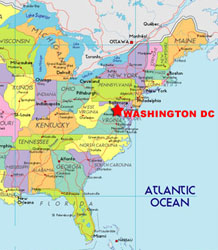 and
beach music. It originated in the Washington, D.C. area, and
many there regard it as the official swing style of Washington D.C.
It started in the mid-1950s, pre-dating American Bandstand. It's
original names are "D.C. Hand Dance/Hand Dancing", "D.C.
Swing", and "D.C. Style." It glides, slides, digs deep
into the floor,. They call it smooth, but t has a good bounce, in general
more so more than most West Coast Swing dancers. Although there are
no aerials, it has the common turns seen in other swing dance styles.
As usual, there are 6 and 8 count patterns. It's triple step 6-count
basic is unique, replacing a rock step with a kick-ball-change,
and the triples are sailor steps (slight hook behind on first
beat of each triple. The name "Hand Dance" arose to
distinguish it as a "connected" dance, rather than the breakaway
styles which came about five years later: the Twist, the Pony, etc. and
beach music. It originated in the Washington, D.C. area, and
many there regard it as the official swing style of Washington D.C.
It started in the mid-1950s, pre-dating American Bandstand. It's
original names are "D.C. Hand Dance/Hand Dancing", "D.C.
Swing", and "D.C. Style." It glides, slides, digs deep
into the floor,. They call it smooth, but t has a good bounce, in general
more so more than most West Coast Swing dancers. Although there are
no aerials, it has the common turns seen in other swing dance styles.
As usual, there are 6 and 8 count patterns. It's triple step 6-count
basic is unique, replacing a rock step with a kick-ball-change,
and the triples are sailor steps (slight hook behind on first
beat of each triple. The name "Hand Dance" arose to
distinguish it as a "connected" dance, rather than the breakaway
styles which came about five years later: the Twist, the Pony, etc.
When Promoters began
to hold regional competitions aimed at attracting National Stars across
the USA, many top swing dancers (and everyone else) were introduced
to styles of other parts of the country. There began a tremendous stylistic
cross-pollination. West Coast Swing in particular affected a lot of the top Hand Dancers,
as well as Shaggers and Lindy Hoppers. As a result, the distinction
"Old School" arose in Hand Dance for the pre-cross pollination
style.
Kick-Ball-Change Hook-Step Step Hook-Step-Step
+1 +
2 + 3 + 4 +
5 + 6 +
|
